domingo, octubre 26, 2008

sábado, octubre 25, 2008

'Ciccio' Graziani


Un GRANDE del futbol Italiano (y de La Roma) que, en este caso, grabó un 45rpm. Kitsch Romano.

A las 7pm; Nota en Radio FM Palermo (musicalizando el Programa!)


Y este sábado, ANDREA PRODAN, será nuestro co-conductor invitado. El músico y actor nos estará acompañando, además de anticiparnos la presentación que dará esa misma noche en PLASMA con su agrupación ROMAPAGANA.

viernes, octubre 24, 2008

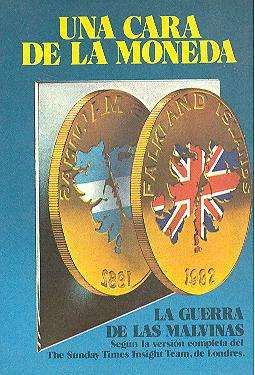
Preparativos Argentinos, Espionaje Británico...


Pocos los Porteños...


Un Boeing 707 de Aerolineas Argentinas transformado en Transportador de Tropas a Malvinas. "Un Saludo para Mamá, muchachos!"

MUCHOS años despues, algunas verdades suben al flote...

Secret Falklands fleet revealed

Lord Owen said similar action should have been taken in 1982
A Royal Navy task force was sent to the Falkland Islands to defend them from Argentine attack five years before the war there, archive papers have shown.
The flotilla led by nuclear-powered submarine HMS Dreadnaught was thought to have deterred a 1977 invasion.

James Callaghan's government secretly ordered Operation Journeyman after 50 Argentine "scientists" landed on South Thule, prompting fears of an attack.

The details have been disclosed for the first time by the National Archives.

The Argentines eventually invaded the Falklands five years later in 1982.

Intense secrecy

Lord Owen, who was foreign secretary in 1977, said that if Margaret Thatcher's Conservative government had taken similar action to that of five years earlier, the war would not have happened.

The papers show Lord Owen insisted the 1977 mission was conducted in intense secrecy. Even the crews did not know where they were going.

OTHER ARCHIVE RELEASES


UK Watergate report
Wilson feared island spies

"There is no need for anyone to know the destination of the frigates. They should be sent on exercise in the Atlantic," he said.

"Only at sea need they know they are going south, even then I cannot see why anyone, other than the captain, should be told their purpose."

The Argentine government was privately warned by the UK that a nuclear submarine was in the area, but other countries were said to be unaware.

The archive papers show there was much nervousness in Whitehall, especially over the operation's legality.

'Risk to life'

Ministers wanted to create an "exclusion zone" around the islands - as happened in 1982 - but notes warned that could be "politically escalatory, probably illegal and could set an unwelcome precedent".

The issue was fudged as Attorney General Sam Silkin was only asked for his advice on the legal situation after the fleet left.

Concerns were so high, HMS Dreadnaught was told if it was attacked by Argentine anti-submarine weapons it must "surface or withdraw at high speed submerged, whichever will be of least risk to life".

Cinísmo á la Macchiavelli, sin duda.

....many Argentine nationalists have long suspected: that Britain came to the rescue of Falkland Islanders in 1982 because it was determined to secure long-term strategic and resource-based interests in the South Atlantic and Antarctic. More widely, other countries, especially in the third world, will look upon this development as further evidence of a select group of countries attempting to colonise the Antarctic and the Southern Ocean for their benefit rather than the international community

Gardel no era Francés?

The Spanish name for the islands, "Islas Malvinas", is derived from the French name "Îles Malouines", bestowed in 1764 by Louis Antoine de Bougainville, after the mariners and fishermen from the Breton port of Saint-Malo who became the island's first known settlers.

HMS SHEFFIELD orgullo de la marina britanica y hermano gemelo del Coventry


Durante mis 12 años de educacion en Inglaterra tuve la singular oportunidad de vivir, por UNA SEMANA, a bordo de este Guided-Missile Destroyer, conviviendo con los marineros.
Cuando, tres años después, este barco de última generación fue hundido por aviones Argentinos (país donde vivía mi hermano), lo absurdo de todo conflicto bélico me pegó fuerte.

Los Macro y Micro aspectos de TODA la guerra de Malvinas/Falkland

jueves, octubre 23, 2008

Sons of the SS Banner, Romapagana

The
Sons
of the
Star -Spangled
Banner
are here...

Devo, Girl you want, cover by Romapagana

Version de tema de DEVO (año 1997)

lunes, octubre 20, 2008

domingo, octubre 19, 2008

mattone volante

Algo sobre Arthur Russell. Si no lo conocen, es hora de investigar...


The story of Arthur Russell's life is easy to mythologize. A Midwestern farm boy runs away from home to the hazy streets of San Francisco, befriends Allen Ginsberg, and is locked in a closet by a half-assed charlatan who at least has the wit to recognize Russell's talent as a cellist. Then suddenly Russell relocates to Manhattan where he shares a street address with the likes of Ginsberg and Richard Hell. Without skipping a beat Russell befriends and collaborates with The Modern Lovers' Ernie Brooks; Philip Glass; David Byrne; Robert Wilson; and other luminaries of the New York City avant-garde and, more importantly, of the burgeoning disco scene.

Almost overnight Russell is producing groundbreaking experimental disco tracks under a host of aliases, all while continuing to explore his primary interests: his cello and his voice. Despite his quest for popularity, Russell descends into self-doubting paranoia which leaves him at home endlessly recording and re-recording songs dedicated to this lover, Tom Lee, before eventually falling prey to AIDS in 1992.

"Flaco, tu banda es DE MADERAA!"

Demasiado Tarde?


Let's join Eric Joyner

A little CRUMB

Falta menos de una semana...

El Jardinero

sábado, octubre 18, 2008

Nelle,Kustu and The No Smoking Pagans

Viernes, 17 de Octubre de 2008


Por Facundo García

Si alguien pretende balcanizar Latinoamérica, que lo intente a la manera de Emir Kusturica. El músico y cineasta serbio se presentó el miércoles con la No Smoking Orchestra, munido de una seguidilla de canciones etno-rockeras que catapultaron a todos hasta los confines de la madrugada. Su séptimo concierto en Buenos Aires –el segundo en el Luna Park– no sólo puso a delirar a más de 8 mil personas sino que confirmó una relación de empatía y familiaridad que se da con muy pocos artistas europeos.

Quién sabe: a lo mejor hay planos de la realidad en que los límites geográficos se alteran. Espacios emocionales donde Europa del Este y la Argentina están pegaditos, compartiendo esa disposición agridulce de emociones, o esa capacidad para celebrar sobre sucesivos Titanics. No por casualidad la banda salió al escenario con el himno de la Unión Soviética, para que acto seguido Kusturica –Kusta, para sus compatriotas– lanzara el punteo de guitarra que abrió la ceremonia. Inmediatamente apareció Nelle Karajilic, panzón que ostenta el cargo de “jefe anárquico” de la troupe. De rojo brillante, el petiso se ocupó de que varios terminaran preguntándose si era un genio o un desequilibrado mental y no desperdició ni un minuto del espectáculo en la tarea de profundizar esa duda. Con “Drag Nach Hosten” –hit reconocible aun para el oído más perezoso– alcanzó una velocidad crucero que se mantendría toda la velada.

Para explicar lo que siguió sería conveniente superponer postales. Una tendría a Kusturica dándole duro a la viola, con su cabeza tapada por un sombrero de paja. Frente a él, el público componiendo un pogo masivo; y alrededor los músicos de la ex Yugoslavia haciendo trencito, como si estuvieran en el cumpleaños de su tío. La amalgama entre actitud punk y algarabía casamentera completaron el combustible para un viaje que avanzó con pedidos de más y más unza unza.

“Lo que está abajo / debería ir para arriba / y lo que está arriba / tiene que ir abajo”, marcaron en “Upside Down”. Aunque la letra era en inglés, las ideas llegaban perfectamente. El entrevero de idiomas, films y canciones llegó al punto en que la multitud se ponía como loca ante la sola mención de títulos como Underground o Gato negro, gato blanco. Obras para el cine, pero evidentemente para un cine que está muy lejos de agotar su experiencia en una sala o en el living. En efecto, “Evropa” –incluida en Tiempo de gitanos– hizo que se coreara unánimemente contra la tele comercial y sus valores: “¡Fuck you MTV!”, bramó la voz colectiva.

Es llamativo que nadie se refiriera a la cinta sobre Maradona que el hombre nacido en Sarajevo acaba de estrenar. Tampoco hubo música nueva. Sí, en cambio, redobladas muestras de lo que generan temas ya clásicos. Junto a pruebas como tocar el violín con una plica gigante, los artistas invitaron a bailar a más de diez mujeres (incluyendo a una señora que ahora lo debe estar contando en la peluquería). La No Smoking les cantó serenatas, las hizo danzar y las metió en una ronda que giraba haciendo pasos militares bufos. Ellas saludaron, sacudieron su humanidad y hasta se animaron a volver con el público mediante un par de clavados kamikaze.

Bordeando los bises, llegaron “Devil in the Business Class” y la pantomima pimpinelesca de “Was Romeo Really a Jerk?”. El cantante –siempre a mil– había cambiado su camisola por la casaca de Excursionistas. “¿Saben? Fue el primer equipo que conocí acá, qué le voy a hacer”, se sinceró. El ritual terminó con percusión y más fuerza, entre fans a los que se les empezaban a derretir las resistencias. Luego, el himno soviético otra vez, para dar paso a la siguiente etapa de la noche, del otro lado de las tarimas. Transpirados a más no poder, los serbios improvisaron una asamblea en los camarines, para propiciar una asociación de “unión serbio-argentina”. Dirigía el evento el flamante presidente de la entidad, un argentino que es responsable de haber contagiado la pasión por Excursionistas. Alrededor de las dos y media, Kusturica conversó con PáginaI12 en un rincón de un bar palermitano. “¿Por qué ese contacto tan intenso con la gente de acá?”, fue la primera consulta. “Pasa que en el fondo ambos venimos de pueblos politeístas”, contestó. “Es verdad que acá y allá hay católicos, musulmanes, judíos, etcétera. No obstante, creo que compartimos el hecho de sospecharnos básicamente paganos. Si a eso le suma la confianza que tenemos en la intuición, todo está clarísimo.”

Por último, Kusta –que según sus allegados suele pasar los días en una villa que ha hecho construir a la medida de sus fantasías– reconoció que tantas citas a la revolución “tienen mucho de broma” y enfiló para el lado del bailongo: en su remera persistía un Che Guevara que se difuminó entre amigos que incitaban a no perderse la fiesta.

miércoles, octubre 15, 2008

Nele Karajilic sings in this, HIS band...


Maradona by Kusturica (Spain/France, 2008): A Political Documentary
Maradona by Kusturica (2008), an updated version of a documentary that was partially released in 2005 or 2006, played at Cannes in May 2008 and was released across France shortly thereafter. The posters advertising the film and featuring a campy-looking disheveled Kusturica in front of a Maradona mural were ubiquitous — all over the Paris metro, all over popular public hang outs like Les Halles or around MK2 Bibliotheque. I saw the film at the MK2 Quai de Loire/Quai de Seine complex in an afternoon screening which was attended by about 15 audience, not bad for a matinee on a weekday. So far the film has only played theatrically in France and Italy where Kusturica still has a strong fan base; an eventual DVD release is likely to give it a better international exposure. It is unlikely, however, to see this film released in the USA or the UK. I would be glad to be proven wrong on this prediction. However, I believe that British and American distributors are likely to find it awkward to make available to their domestic constituencies a film that is full of harsh comments on key politicians and political moves taken by the UK or the USA over the past decades (especially as some of these moves, like the Falklands war or the bombing of Serbia in 1999 enjoyed a degree of popular support here). It is an open question how such not releasing the film should be interpreted, and it is one that is raised in different ways throughout this political documentary, which asks essentially if there is space for opinions and worldviews that dare to differ.

Those who expect to see a portrait of football star Maradona here may be in for some disappointment. Surely, Maradona is present, there is extensive footage of him as a child, of him as the world’s best footballer, of him as a loving family man, of him as a vulnerable ill man in later years, of him as a recovered addict, and so on. The focus of the film, however, is on Maradona’s politics and his view of the imbalances of the world, especially where his politics intersects with Kusturica’s views. At the Cannes press conference on the film Maradona said that ‘we are not all obliged to think as the Americans do’ and pointed out that people living in different countries are entitled to interpret international politics from the point of view of where they stand in the world. It is precisely the combination of this conviction (the right to differ and speak up) and the high visibility of Maradona (and of Kusturica himself) that the director uses to turn the film into a political documentary that accommodates dissenting views that need to be aired.

There is quite a bit in Maradona by Kusturica that is not usually seen widely or positively covered in mainstream media in the West: Maradona’s admiration for Fidel Castro and Hugo Chavez, his visit to Belgrade in the aftermath of Kosovo, Kusturica’s views on the adverse effects of IMF and G8 policies on countries in Latin America and elsewhere, plenty of animations that caricature American and British politicians. The film is most certainly not ‘politically correct’, an intended effect that the the director clearly seeks to achieve. Having endured all sorts of criticisms of his politics in the aftermath of Underground, Kusturica has clearly resolved to speak up his mind. It is probably this resolve that characterizes his recent work as well as the reason that brings Maradona and Kusturica together stronger than their love for football.

Writing in Screen International from Cannes, Jonathan Romney gave it a reserved review, saying that the film is as much about Maradona as it is about Kusturica. I believe he is right in this observation, but while Romney seemed to mean this in a critical sense, I see this merger between object and author of the documentary as one of its most interesting aspects. What brings the footballer and the director together is not simply Kusturica’s fandom and his admiration for Maradona, and it is not simply the fact that, as Kusturica said at the press conference at Cannes, both he and Maradona are very Dyonisian, in a sense that chaos dominates over rationality. Equally important is the fact that they both belong to peripheral nations that see themselves as having been wronged by America and Britain and that they are both prepared to use their celebrity to bring into the public space a piece of political commentary that is alive but confined to subterranean popular discourse and, if not brought to light by figures of their degree of visibility, would remain fully shut out.

The footage of Maradona’s faithful 1986 World Cup goal in Argentina’s semi-final against England is replayed repeatedly not just for the sake of football lovers, but mostly to reiterate all over again a situation where a weaker nation scores against an imperial power that has just defeated it in a war. In an interview in the French film magazine Split Screen Kusturica explains that the intention was for the film to evolve around the goal that Maradona scored after dribbling seven English players during this legenday match between Argentina and England, an event that is taking place not long after the war between Argentina and the UK over the Falkland islands. Each part of the film returns to a replay of this memorable goal, and each one of the seven English players passed, Kusturica says, is then ‘transformed into some personality that has made our lives difficult, likewise for the Argentinians and for the Serbs: Margaret Thatcher, Ronald Reagan, George Bush’ (Split Screen, Autimn, 2007, p. 6). Political personalities that that are featured as adverse figures in the animated sequences of the film include Bill Clinton, Tony Blair, the Queen and even Prince Charles.

The film includes many memorable scenes which Kusturica has opted to leave without much commentary or contextualization as they are sufficiently expressive on their own. One is the specific fan ’siege’ that Maradona experiences during a visit to Naples, showing the menace of crowds and revealing the downside of celebrity. Another one is a scene in a karaoke bar, apparently in Argentina, where the footballer has come with his wife, daughters and friends. At one point Maradona stands up and delivers a memorable performance at the mike, a seemingly improvised song in which he talks about his life, his ordeals, his mistakes, and his optimism. It is powerful and impressive. The point of the interconnectedness between the two men is clearly articulated throughout the film. At concerts of his rock group No Smoking Orchestra, Kusturica is routinely introduced as “The Diego Armando Maradona of cinema”. In the documentary he goes a step further and continuously uses excerpts of his own films, from Dolly Bell (1981) and When Father Was Away on Business (1985) to recent Life is a Miracle (2004) and Promise Me This (2007), thus cross referencing Maradona’s story with his own life, with his artistic concerns and vision.

Maradona and Kusturica compare in more aspects: they both achieve fame at a relatively early age, they both ‘have it all,’ they both have been exposed to harsh public criticism at one time or another, and they both are resolved to live as they believe they should, in spite controversy or adversity. In that, I believe that Maradona by Kusturica is a film of key importance in the director’s career, an act of soul-searching in the process of portraying someone else.

My favorite moment is the final scene, which is clearly set up by the director and yet has an incredible degree of spontaneity as it seems it came as a surprise to the footballer. Maradona is leaving the site where they just shot an interview just as one of two inconspicuously looking guys with guitars leaning at the graffiti-sprayed wall opposite begin singing a song, it is all very casual. One gradually realizes that the singer is Manu Chao, the famous transnational musician, who is performing his La vida es una tombola, the lyrics of which open with the conditional ‘If I were Maradona…’ and then go on saying how one would live and that one would not regret about anything. Maradona approaches and stands in front of the singer, listening. He is wearing dark glasses, but one can see that, behind the shades, he is crying.


© Dina Iordanova
13 September 2008


--------------------------------------------------------------------------------

'El Puente' de: Mario Gomez (Arg.2008)

http://elpuentefilm.blogspot.com/

La pagina de la pelicula 'El Puente' que protagonizo y que se filmó hace pocos meses en la provincia de El Chaco y Córdoba. Está en fase de Post-Producción actualmente.

martes, octubre 14, 2008

Our Man EMIR

Wikiprod

ROMAPAGANA


ROMAPAGANA is an Argentine Rock Band, based in Buenos Aires. It's sound could be considered a 'progression of Punk rock', although it has its roots in music of no distinctive category. The band was formed in 1994, and first performed for a public in the 'Excentrico de Monserrat' bar, on Alsina Street,Buenos Aires. It's first 'oficial' gig was in 'Crimson', a now defunct Club, on Chile Street. The band consists in :

Andrea Prodan.... Voice and Guitar
'Rojo' Limardo... Guitar
Diego Segovia.... Bass
Cristian 'Pistón' Fernandez... Drums
The songs of this band are mainly in English, although songs in Spanish are also part of their act ('Ordeñaste,mi amor?','Waco', etc.)

Ecology and Socio-political problems are tackled in many of the songs.

ROMAPAGANA maintains a decidedly low profile. A dogged desire NOT to enter 'the supermarket of wholesale Rock' helps this band make its choices as coherent as possible. Their success is based casi-exclusively on word-of-mouth reputation.

Despite the 'High Octane' level of their sound, ROMAPAGANA look forward to a PEACE-INSPIRED planet. They profess to be making as much use as posible of the last resources of ENERGY that they can get their hands on, as - in their book- Electricity and other sources of centralized power will soon be severely rationed by World Governments.... ESPECIALLY 'Third World' governments.

Retrieved from "http://en.wikipedia.org/wiki/User:Wikiprod"

lunes, octubre 13, 2008

news movie

Yukio Mishima: last moments

Bring Me the Head of Yukio Mishima by the Snivelling Shits

AXE 3 Werbung 2008

Ah... bueno! Acá aparece otra version, más corta... y para el mercado Aleman!
(ni lo sabia!)

axe crash

A parte 'Viva Voce', Maltrtan Hamsters y ROMAPAGANA.... está mi TRABAJO!
Acá va una que escribí y canté por CCCI y que se vendió para el mercado Anglo-Sajón.
El 'spot' se vió en Argentina, pero con otra musica.

Andrea Prodan

Desert Rose (no oficial)

Articulo de Marcelo Fernandez Bitar

Protótipo de Tapa y interior de mi disco 'Viva Voce' (1995)


Special Correspondence


Lo que pasó a Britannicus,hijo de Claudius y verdadero heredero al trono Imperial, en lugar de Nero


Britannicus survived for a few months under the rule of his adopted brother, mostly ignored, but the doings of his stepmother Agrippina led to his death. In early 55, one of Agrippina's favorites, the freedman Pallas, was sacked from his job as secretary of the treasury - a post he had held since the reign of Claudius. According to Tacitus, Agrippina reacted violently to this slight by Nero. She declared that she repented of her actions to bring Nero to the throne, and would throw in her lot with Britannicus, the true heir who would soon come of age. She threatened to take the boy to the Praetorian camp, where she would admit to murdering Claudius and Britannicus would be declared emperor. Nero did not take this threat lightly.
Tacitus recounts Nero's numerous attempts to publicly undermine Britannicus' image. One such attempt was when Nero asked Britannicus to sing at a drunken party, months before his 14th birthday. Britannicus however, not only avoided humiliation, but also generated sympathy amongst the guests, after singing a poem telling the tale of how he had been cast aside in favour of Nero. Tacitus also stated that a few days before his death, Britannicus was sexually molested by Nero.
According to Tacitus, Nero moved against Britannicus, employing the same poisoner, Locusta, who had been hired to murder his father, Claudius. The first dose failed, and Nero decided to throw caution in the wind. Britannicus was poisoned at a dinner party attended by his sister, Claudia Octavia, Agrippina, and several other notables. The assassin avoided being given away by a food taster by adding the poison to his drink when Britannicus asked for it to be cooled, as he felt it was too hot. The substance was instantly fatal, and Britannicus fell to the floor foaming at the mouth. He died on February 11, 55, one day before his 14th birthday, less than a month before he was to assume manhood, and just four months after his father's death[3]. Nero dismissed the murder by claiming that the boy suffered from epilepsy. Some modern historians, particularly Anthony Barrett, suggest that he may have indeed suffered from the disease, and that a particularly bad seizure killed him. This may also be the reason for his eclipse by Nero - although Claudius never spurned his son on purpose. Britannicus was quickly buried in the Mausoleum of Augustus, the last of the Julio-Claudians to be interred there.
According to Suetonius, Britannicus was good friends with the future Emperor Titus, whose father Vespasian had commanded legions in Britain. As part of the Flavian's attempts to link themselves with the Julio-Claudians, Titus claimed that he had been seated with Britannicus on the night he was killed. He even claimed to have tasted the poison, which resulted in a serious and long illness. Titus would go on to erect a gold statue of his friend, and issue coins in his memory.

Hoy mataron a Claudius


viernes, octubre 10, 2008

rocky intro

MAÑANA!


Rocky Horror Picture Show - I`m going Home

Curry Impressionante en este momento de The Rocky Horror Picture Show.

Rocky Horror Picture Show [scene 22]

"... or SANE persons!"

Rocky Horror Picture Show [scene 30]

Budget bajo
Grandes Ideas y
Escenografia maravillosa...
Ah,
y los actores y musica!

Wild Horses-The Rolling stones

Best Version?
Great Song!

miércoles, octubre 08, 2008

XTC - 14. Battery brides.mpg

Mouse on Mars - Twift Shoeblade (LIVE)

Hey! They've been listening to XTC's 'GO +'
ep (the rare one with dub versions of their songs...). This is like 'Dance with me, Germany' the cover of 'battery Brides'.
At least Mouse on Mars have GOOD taste when it comes to inspiration!
Bye from Argentina!

David Brent welcomes the Swindon Lot

Antes de ver lo que sigue abajo... si tienen tiempo... una PERLA del humor Inglés.

Full Metal Jacket - Motivational Speech

Tres facetas del American-Way-Of-Life

Glengarry Glen Ross speech

Gran Peli de David Mamet

Wall Street - Greed Is Good

This is The Recipe...
now WE are eating the Dish.


No son Bilardo y Bochini...